For a farmer, a weather forecast becomes valuable when it answers a practical question: What should I do on my farm, and when should I do it?
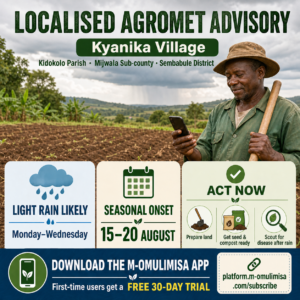
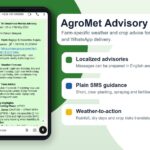
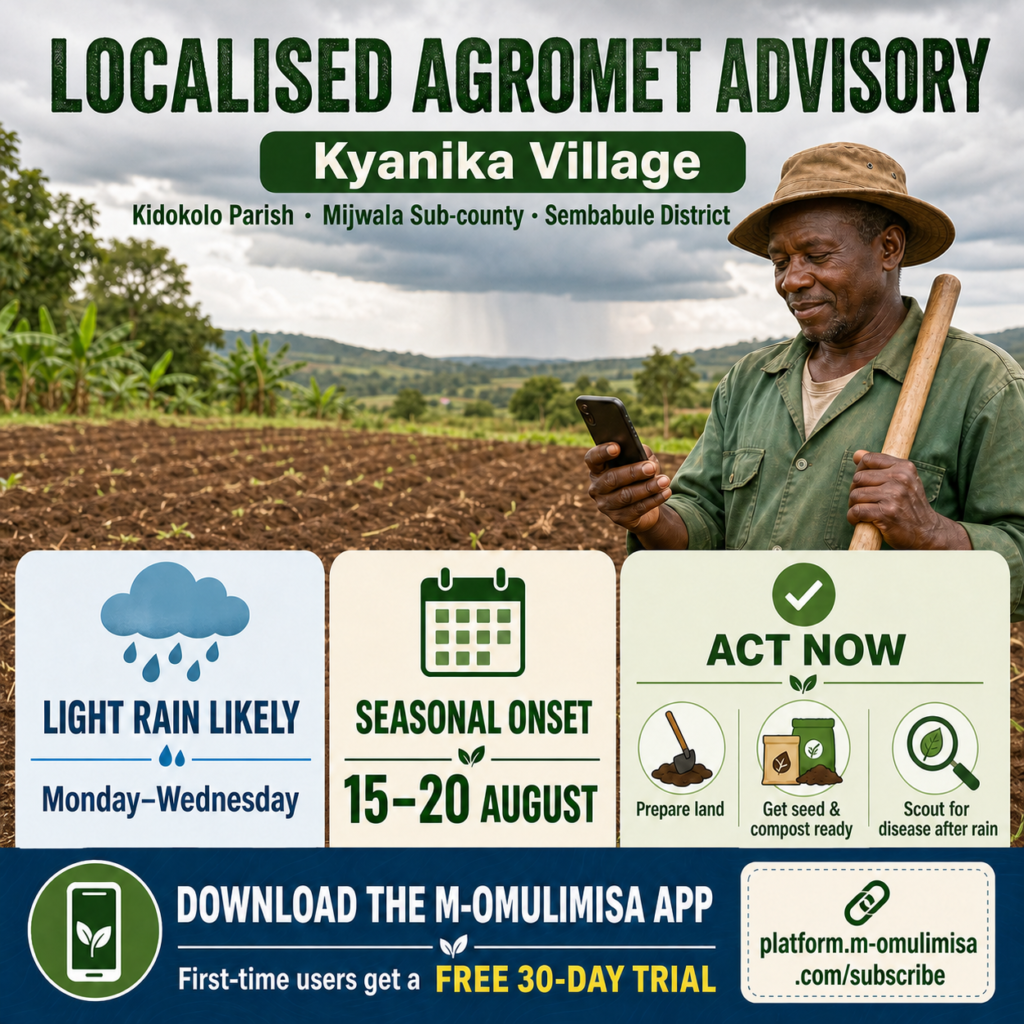
That is the purpose of the M-Omulimisa AgroMet Advisory Service. We translate weather forecasts and agricultural information into localised, practical guidance that farmers can use to plan weather-sensitive activities, including land preparation, planting and crop protection.
Recent follow-up interviews offer an encouraging view of how farmers and agricultural professionals are experiencing the service. Of the 300 farmers currently participating in the pilot, our team has already contacted more than 100. The feedback has been overwhelmingly positive, with farmers reporting that the advisories are understandable, useful and relevant to real decisions on their farms.
Clear information farmers can use
The results from 80 advisory recipients contacted after two months of the pilot illustrate the wider pattern emerging from the service:
- All 80 respondents confirmed that they had received the advisory.
- All described the message as very clear.
- Seventy-eight said the forecast matched the weather they experienced, while two said it partly matched.
- All rated the advisory as very useful.
- All wanted to continue receiving the service.
These responses matter because an advisory cannot support a decision if it is difficult to understand, arrives without useful context or does not reflect conditions experienced by the farmer. Across the broader follow-up effort, occasional partial matches have also been reported. We treat these reports as valuable operational evidence rather than exceptions to overlook.
Turning weather information into decisions
Sixty-five of the 80 respondents said they used the advisory to make or change a farming decision. Their actions included:
- delaying planting;
- preparing land for planting; and
- buying seedlings.
These are practical choices with real consequences. Planting too early can expose seed to dry conditions, while delayed land preparation can cause a farmer to miss a suitable rainfall window. Timely, localised guidance helps farmers prepare before conditions change instead of reacting afterwards.
The feedback also showed potential beyond individual farmers. One respondent was an extension worker supporting five farmer groups in Kamuli, while another was an agricultural officer in Bugweri interested in using the service. Working with extension professionals can extend the value of one advisory to many more farming households.
Listening and improving
Farmer feedback is also helping us refine how advisories are delivered. One respondent asked for shorter messages, noting that farmers may not have time to read lengthy information. Another highlighted the importance of receiving advisories in Luganda. M-Omulimisa already provides this option as part of making agricultural information more accessible.
Feedback on partial forecast matches is documented and shared with our technical partners. These field observations are helping the team refine the product and improve how local weather signals are translated into farmer-facing guidance. In this way, every follow-up conversation contributes to a continuous cycle of validation, learning and service improvement.
We are taking these observations seriously. Effective AgroMet communication must be concise, timely, understandable and available through channels and languages that work for farmers.
Evidence of demand and the need to keep proving value
More than 80% of the farmers contacted said they were willing to pay for the service, while about 5% responded “maybe”. Suggested payment approaches varied, and some respondents wanted more experience with the full platform before naming an affordable amount.
That is a useful reminder: farmer trust is earned through consistent value. Our priority is to keep improving forecast relevance, make recommendations easier to act on and demonstrate how timely information can help farmers manage risk throughout the season.
Try M-Omulimisa AgroMet advisories
The pilot evidence is strongly encouraging: farmers understand the advisories, find them useful and are applying them to real decisions. As we complete follow-up with more of the 300 pilot farmers and gather evidence across additional seasons, we will continue learning, validating and improving the service.
Would you like localised weather and farm-management guidance tailored to your location?
Download the M-Omulimisa app and start your free 30-day trial.
Sign up for the M-Omulimisa AgroMet Advisory Service
M-Omulimisa also welcomes partnerships with farmer organisations, extension services, development programmes and other institutions working to strengthen climate resilience in agriculture.